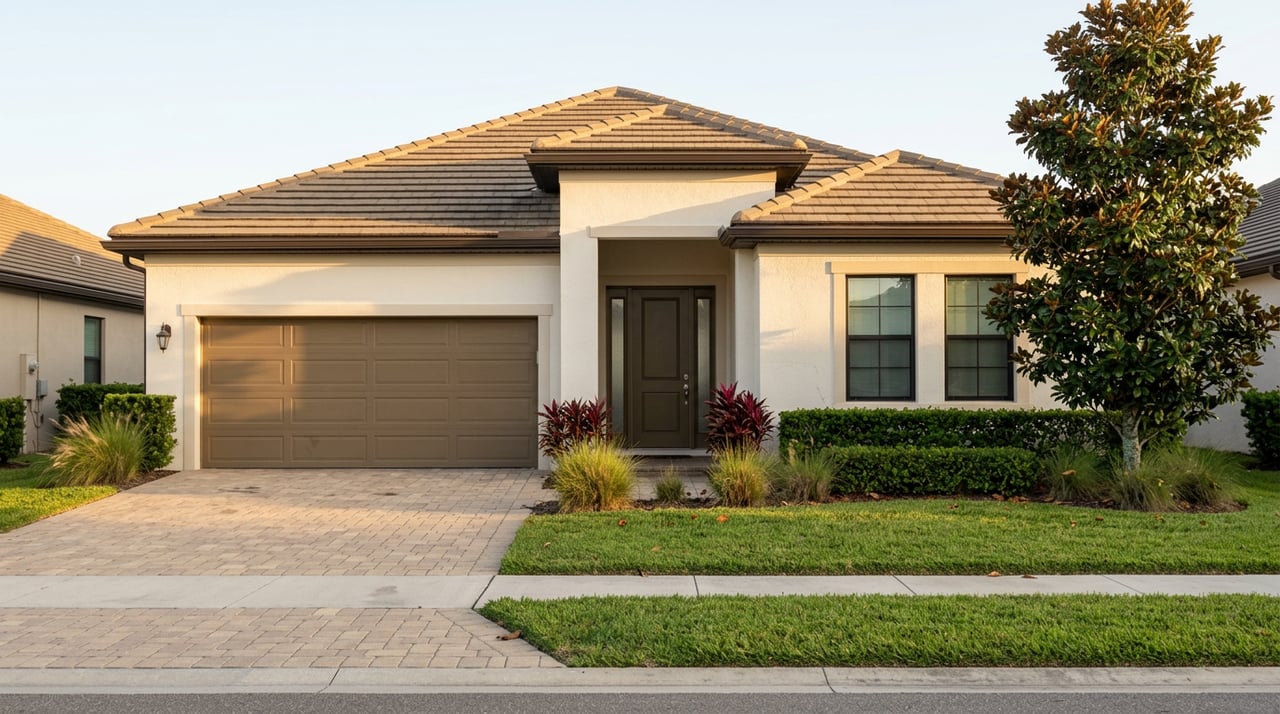
Two four-bedroom homes go under contract in New Tampa the same week, ten minutes apart, within a few thousand dollars of the same list price. One buyer's total monthly housing cost lands close to what the listing sheet implied. The other's comes in a few hundred dollars higher, and the gap has nothing to do with the mortgage rate they locked or the inspection they negotiated. It comes from two numbers that never show up in the Zestimate: whether the parcel sits inside a Community Development District, and how long the seller had held the homestead exemption before the sign went up.
If you are comparing New Tampa communities right now, that gap is the thing worth understanding before you fall in love with a floor plan.
The Same List Price, Two Different Bills
A Community Development District, or CDD, is a special-purpose local government created under Florida law to finance a subdivision's roads, ponds, gates and clubhouses through bonds, then repay those bonds through an annual assessment. That assessment does not show up on the HOA statement. It shows up as a separate line on the county tax bill, which is exactly why it is easy to miss until closing week.
New Tampa's master-planned communities handle this in genuinely different ways, and the differences are large enough to matter in a monthly budget:
| Community | Fee structure | What typically shows on the tax bill |
|---|---|---|
| Hunter's Green | HOA dues to the Hunter's Green Community Association; optional Tom Fazio golf and country club membership billed separately | No CDD line on most parcels |
| Heritage Isles | HOA dues plus a CDD bond assessment | Roughly $2,000 to $2,500 a year on many parcels |
| Tampa Palms (Promenade section) | Master HOA plus a TPOST CDD assessment | Around $1,012 a year on a Promenade-section parcel |
| Cory Lake Isles | Minimal HOA, as low as about $200 a year, plus a CDD | Commonly cited around $200 a month, roughly $2,400 to $2,468 a year depending on the parcel |
| K-Bar Ranch | HOA plus an active K-Bar Ranch CDD, currently funding an amenity improvement project | Confirm current assessment roll with the district |
These figures come from listing data and CDD disclosures gathered across recent parcels, not a single community-wide rate, because CDD assessments are set per lot size and per district budget year. The point is not that one number is right and the others are wrong. It is that "no CDD" is not automatically the cheaper choice, and a CDD line is not automatically a red flag. Hunter's Green pays for its golf course and clubhouse through an optional club membership instead of a bond assessment. Cory Lake Isles pays for its beach club, boat ramp and 165-acre lake through the district. Both are legitimate ways to fund the same category of amenity. What changes is which column of your budget the cost lands in, and whether it is optional.
That distinction only holds up if you check the parcel, not the community's reputation. The same subdivision can carry different assessments block to block depending on when a section was built and which bond series covers it.
The Second Number Nobody Puts On The Listing
The CDD line is visible if you know to look for it. The tax reset is harder to spot because it depends on something you cannot see from a listing: how long the current owner has held the homestead exemption.
The Pinellas County Property Appraiser explains that Florida's Save Our Homes provision caps how much a homesteaded property's assessed value can rise each year, generally to the lesser of 3 percent or the change in the Consumer Price Index. Over a decade or two, that cap creates a growing gap between what a home is worth on paper and what it is actually taxed on. A longtime Hunter's Green or Tampa Palms owner who bought in the 1990s or 2000s may be paying tax on an assessed value far below the home's current market price.
That gap does not transfer to the buyer. When the home sells, the assessed value resets to market for the new owner's first tax year, as the Hillsborough County Property Appraiser explains. If you are the buyer, your year-one property tax bill is not based on what the seller was paying, which means the "current taxes" figure on the listing sheet is close to meaningless for estimating your own bill.
If you are the one selling a longtime Florida homestead to buy again in New Tampa, the mechanism works in your favor through portability. According to Pegasus Lends, Florida lets you transfer up to $500,000 of that Save Our Homes assessment gap to a new homestead anywhere in the state, including a move from a Pinellas County homestead into Hillsborough County, as long as you establish the new homestead within three tax years and file the transfer paperwork, commonly Form DR-501T, with the new county's property appraiser by March 1. It is not automatic. You apply for it the same year you apply for your new homestead exemption.
Why August Is the Month to Pay Attention
Hillsborough County mails its annual TRIM, or Truth in Millage, notices by the end of August, according to the Hillsborough County Property Appraiser, so buyers who close around the time the notices arrive may get their first look at the assessed value and proposed millage within weeks of moving in. The Hillsborough County Property Appraiser identifies the notice as the window to formally contest an assessment you think is too high through the county's Value Adjustment Board.
This year, two property-tax developments are worth knowing if you are timing a purchase. A ballot measure headed to Florida voters in November 2026 would enlarge the non-school portion of the homestead exemption, according to Pegasus Lends. Worth knowing if you are watching for it: this measure does not touch the Save Our Homes portability rules described above. A related proposal that would have removed the $500,000 portability cap entirely died earlier in the legislative session and will not appear on the ballot. The portability math you run today is the portability math that applies regardless of how November goes.
What the Median Price Actually Hides
Ask two different sources what New Tampa home prices did this spring and you will get two different answers. One broad tracking service put the March 2026 median sale price at $463,000, down slightly year over year, with homes taking a bit longer to sell than the prior year. A local MLS-based tracker following single-family resale specifically put the first-quarter 2026 median closer to $545,000, up about 2 percent from the same quarter last year, and read that as the market stabilizing after two down years.
Both readings cover roughly the same window, and both can be defensible at once, because they are measuring different pools of homes and different cuts of the market. That disagreement is exactly why the median price alone is a weak tool for comparing two specific New Tampa communities. The CDD line and the tax reset explain more of the real difference in your monthly payment between two similarly priced homes than whichever median headline you happen to read that week.
Before You Write the Offer
A few steps turn these two hidden numbers from a surprise into a number you already know:
- Pull the current non-ad valorem assessment line from the county tax bill for the specific parcel, not a community-wide estimate.
- If the parcel sits in a CDD, request the current adopted budget and assessment roll from the district rather than relying on what the listing agent states.
- Ask your lender how they plan to annualize and escrow the CDD assessment and HOA dues, since this affects your qualifying debt-to-income ratio.
- If you are relocating within Florida and expect to bring a Save Our Homes benefit with you, calculate the transfer amount with the new county's property appraiser before you write an offer, so you know your real year-one number rather than the seller's.
A Few Questions Before You Compare Communities
Does a CDD assessment ever go away? The bond-repayment portion typically retires on a set schedule, sometimes running two to three decades, after which that part of the assessment drops off. The operations and maintenance portion, which funds ongoing upkeep of roads, ponds and common areas, continues for as long as the district exists.
If I'm selling in Palm Harbor to buy in New Tampa, does my tax benefit follow me? Yes. Save Our Homes portability works across county lines anywhere in Florida, not just within Hillsborough or Pinellas alone, as long as you establish the new homestead within three tax years and file the transfer application by March 1.
Is a community with no CDD always the better deal? Not automatically. Compare the full monthly picture, meaning HOA dues, any optional club membership, and the property tax line together, rather than treating the presence or absence of a CDD as a shortcut answer.
If you are weighing New Tampa communities against each other, or against a move from Pinellas County, that comparison gets easier with someone who pulls the actual tax bill and assessment roll before you get attached to a floor plan. Michele Ranjbar works both sides of the Tampa Bay market and can walk you through what a specific parcel will really cost before you write an offer. Start with a free home valuation or browse the full New Tampa neighborhood guide to see what is currently on the market.
This article is general information, not legal, tax or financial advice. Consult a qualified professional about your situation.