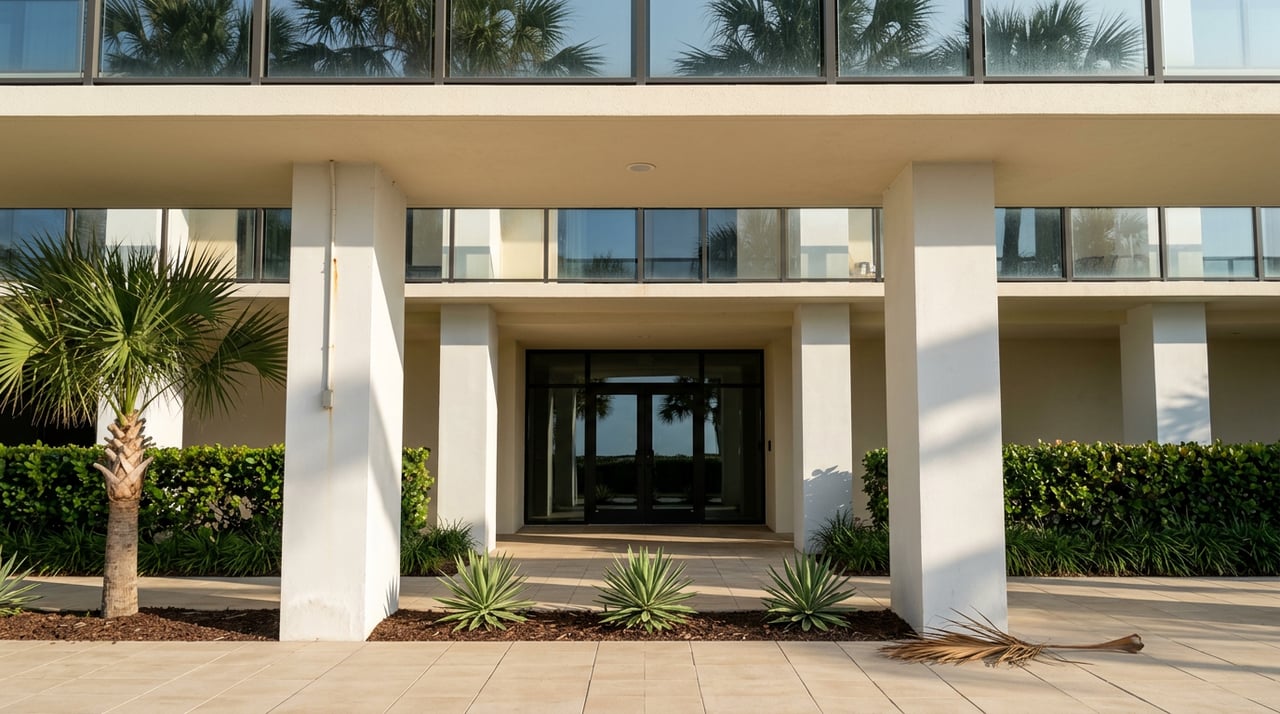
Picture two South Pinellas condos, listed the same week, same price bracket. One sits in a brand-new tower rising along the downtown St. Petersburg skyline. The other is a resale unit in one of the older high-rises near Tierra Verde or Pinellas Point, the kind of building that was permitted decades ago when height variances were still generous. One of those two buyers closes in five weeks with a conventional loan. The other loses financing twice before the deal falls apart. Nothing about the listing sheet explains the difference. The median price never will. What separates them is a status neither building's marketing photos mention.
That distinction has gotten sharper in 2026, not softer. A wave of post-Surfside inspection and reserve rules is now colliding with a set of new federal lending rules, and the two together are deciding, building by building, which South Pinellas condos are financeable and which ones aren't. Whether you're looking downtown, along the Tierra Verde and Skyway Marina corridor, or in one of St. Petersburg's older waterfront towers, that gate matters more than the number on the sign.
The New Towers Still Need the Same Paperwork
It's tempting to assume this is only an old-building problem. St. Petersburg's downtown skyline says otherwise. Valor Capital's 29-story Roche Bobois Residences, approved for the corner of 4th Street South and 4th Avenue South, and Reza Yazdani's 12-story Marina Bay Residence, planned along the Pinellas Bayway near Eckerd College, are both part of the current wave of new construction reshaping South Pinellas. Neither building is old enough to trigger a milestone inspection for decades.
According to The HOA Guide, Florida's structural integrity reserve study requirement doesn't care about age the way the milestone inspection does. It's triggered by height, three stories or more, not by how long the building has stood. A condo tower that finishes construction in 2028 still has to have a SIRS on file. Buyers drawn to South Pinellas because a listing is new construction shouldn't assume that newness makes the reserve conversation irrelevant. It changes what a buyer should ask for, not whether they should ask.
Older buildings carry the sharper version of this problem, and South Pinellas has plenty of them. High-rises like the Point Brittany towers near the Pinellas Bayway were permitted to rise as tall as 175 feet decades ago, well before today's inspection and reserve rules existed. Buildings from that era are exactly the ones now working through milestone inspections and reserve studies for the first time under the current law, and exactly the ones a lender will scrutinize hardest.
Passing Inspection Is a Snapshot, Not a Warranty
The rest of the county offers a useful, if uncomfortable, preview of what that scrutiny can turn up. In Clearwater, on the county's north end, the twelve-story South Beach Condos III was evacuated in May 2025 after workers found a widening crack in a support pillar, according to reporting from WTSP. The building had already completed its state-mandated milestone inspection the year before, and that report hadn't flagged anything that compromised the structure. What it did flag was a section of deteriorated garage slab. Crews were mid-repair on exactly that slab when the crack appeared.
The building wasn't cutting corners. It had done what the law asked. The lesson for a South Pinellas buyer is the same regardless of which end of the county the story happened in: a milestone inspection report is a snapshot, not a warranty. A report filed in 2024 tells a buyer what a licensed engineer saw that year. It says nothing about what a hurricane, a repair crew, or another eighteen months of salt air might do next.
City officials in Clearwater told WTSP in the spring of 2025 that roughly a quarter of local buildings hadn't yet filed their required milestone inspections. That figure is well over a year old now, and it describes the county's north end specifically, but it points to a pattern that shows up across Pinellas County, including South Pinellas: inspection status varies wildly from one building to the next, even within the same few blocks.
The Rule That Just Changed Four Weeks Ago
Structural risk is only half of what's reshaping condo financing this year. The other half is happening at Fannie Mae, and it changed on a specific date you can check a calendar for: August 3, 2026. That's when, as Qualified Home Loans reports, Fannie Mae eliminated its Limited Review option for most condo loans. Under the old rule, certain purchases with larger down payments got a streamlined look at a building's finances. Under the current rule, nearly all condo loans require a full review, meaning lenders now dig into an association's budget, reserve funding, insurance, and any pending litigation before a loan closes, regardless of how much the buyer is putting down.
Fannie Mae has also signaled where reserve funding is headed next. Its standard requirement is scheduled to rise from 10 percent of a project's budgeted income to 15 percent, phased in starting in 2027. That's a stricter bar layered on top of the state's own SIRS mandate, and it means a building that clears Florida's minimum reserve funding could still fall short of what Fannie Mae wants to see on its books.
Here's what that shift looks like in plain terms:
| Fannie Mae Rule | Before August 2026 | Now |
|---|---|---|
| Project review type | Limited Review available for many purchases | Full Review required for nearly all condo loans |
| Minimum reserve funding | 10% of budgeted income | Scheduled to rise to 15%, phasing in starting 2027 |
| Buyer down payment relevance | Larger down payments could unlock the shorter review | No longer a factor in which review applies |
A buyer with excellent credit and 30 percent down used to have a real shot at a faster, lighter review. That shortcut is gone. The building's own paperwork now decides how the loan process goes, not the borrower's.
Four Months Until the Statewide Deadline
Layer the state timeline on top of the federal one and the urgency compounds. According to the Florida Department of Business and Professional Regulation, Florida law requires condo and co-op buildings three stories or taller to complete a milestone inspection once they hit 25 years of age within three miles of the coast, or 30 years inland, and every 10 years after that. Buildings hitting that threshold in 2026 have until December 31, 2026, to finish both the milestone inspection and, where the two coincide, the structural integrity reserve study. From where we sit today, that's four months away, not four years.
Every South Pinellas building reaching that age window this year is racing the same clock, and it's the same clock every other Florida association with a 2026 deadline is racing too. A board that waits until October to schedule its Phase 1 inspection is competing with associations across the state trying to book the same pool of licensed engineers before the year runs out. Buyers touring listings this fall should ask not just whether a building has completed its inspection, but when it was scheduled and whether the association is already showing signs of the scramble.
What Pinellas Buildings Are Already Carrying
When Fannie Mae's confidential ineligible-projects list was reported publicly in the fall of 2025, Pinellas County already had 238 flagged condo communities on it, the fourth-highest county total in Florida behind Miami-Dade, Broward, and Palm Beach. Given how much tighter reserve and review requirements have gotten since, including the August 2026 change described above, that count has almost certainly not shrunk.
A flagged building doesn't mean the property is unsafe. As attorney Jake Marcus told MPA, "I think it's the perfect financial storm for condominiums in Florida." That storm isn't limited to condos, either, and it isn't limited to South Pinellas. In Feather Sound, an unincorporated community in central Pinellas County between St. Petersburg and Clearwater, homeowners in the Villas of Carillon HOA were notified of a special assessment that could run as high as $60,000 per owner, tied to two decades of underfunded reserves for balcony repairs, waterproofing, and a garage roof replacement, according to WTSP's coverage of the community. The same insurance and reserve pressure is landing on both kinds of associations countywide, South Pinellas included.
Four Documents to Ask for Before You Write the Offer
None of this means South Pinellas condos are a bad buy in 2026. It means the due diligence has moved earlier in the process, before the offer, not after. Ask your agent or the listing agent for these four items before you get attached to a unit:
- The milestone inspection report and its completion date. Confirm whether the building has finished its Phase 1 inspection, and if a Phase 2 was triggered, what repairs it required and on what timeline.
- The current SIRS report and reserve-funding percentage. This tells you whether the association is funding its structural components at a level that satisfies both state law and, increasingly, Fannie Mae's own threshold.
- Board meeting minutes referencing any assessment discussion. Special assessments often get discussed for months before an official notice goes out. Minutes can surface a shortfall before it becomes a bill.
- Written confirmation from your lender of the building's Fannie Mae project status. Ask your lender to check the building directly rather than assuming a favorable review just because a nearby, similar building qualified.
What This Means for Your Negotiating Position
Fannie Mae and Freddie Mac together back roughly 70 percent of residential loans nationwide. When a building falls off that list, the pool of buyers who can finance a purchase there shrinks to cash buyers and borrowers willing to take on a non-conforming loan, which typically means a higher rate, a larger down payment, or both. Fewer eligible buyers usually means longer time on market and softer negotiating leverage for the seller, even if the unit itself is well kept and reasonably priced.
That's the part a median price can't show you. Two condos at the same number can sit on opposite sides of that eligibility line, and the only way to know which side you're on is to ask before you write the offer, not after the appraisal comes back.
Before You Fall in Love With a Listing
South Pinellas still has plenty of condo buildings with clean inspections, fully funded reserves, and no flags on Fannie Mae's books. The point isn't to avoid condos this year. It's to check the building's paperwork with the same seriousness you'd check the unit's square footage, because in 2026, one of those numbers can sink the deal and the other can't.
If you're comparing condos across South Pinellas this fall and want a second set of eyes on a building's inspection status, reserve funding, or Fannie Mae eligibility before you write an offer, that's exactly the kind of groundwork Michele Ranjbar walks buyers through. Visit the buyer resources page to get started, or reach out directly. Make your move with confidence. Request a free consultation before you fall for a listing that your lender won't touch.
This article is general information, not legal, tax or financial advice. Consult a qualified professional about your situation.